- What's climate change?
- How we're taking action on climate change
- Climate risk and resilience assessment
- Reducing greenhouse gas emissions
- Yukon Climate Leadership Council
-
What's climate change?
Climate change refers to the significant changes we are seeing to:
- average temperature;
- precipitation;
- wind patterns; and
- other aspects of the climate in the Yukon and around the world.
The Yukon is already warming at a rate twice as fast as the entire globe.
Studies project:
- temperatures will continue to warm; and
- average annual precipitation will increase and become more variable.
These changes will result in impacts including but not limited to:
- permafrost thaw;
- extreme weather events;
- changes to snow, ice and water; and
- changes to vegetation and wildlife.
Climate change is caused by the release of greenhouse gases such as carbon dioxide and methane. These mainly come from human activities that burn fossil fuels. These activities range from driving vehicles and heating buildings to commercial and industrial processes.
Read more:
-
How we're taking action on climate change
As set out in Our Clean Future: A Yukon strategy for climate change, energy and a green economy, we're taking action to:
- reduce the Yukon’s greenhouse gas emissions from transportation, heating, electricity generation and other areas by 45 per cent by 2030;
- reduce greenhouse gas emissions from the Yukon’s mines per unit of material produced;
- generate 97 per cent of the electricity on the Yukon’s main grid from renewable sources by 2030 on average;
- make sure the Yukon is highly resilient to the impacts of climate change by 2030; and
- build a sustainable green economy.
Learn more about Our Clean Future:
-
Climate risk and resilience assessment
The Yukon climate risk and resilience assessment was a 2-year project completed in 2022. The project:
- reviewed past and projected climate change impacts;
- developed a framework for climate resilience in the Yukon;
- identified areas where climate risks are significant and where we're already taking action; and
- recommended ways to build on Our Clean Future.
This report helps us make informed, forward-looking decisions to decrease the negative ways climate change can impact our health and wellbeing, livelihoods and way of life.
The assessment invited perspectives from across the Yukon and built on public input for Our Clean Future. Participants included representatives from Indigenous and municipal governments, the Governments of Yukon and Canada, Elders, knowledge holders and youth, academia, non-profit organizations and local subject-matter experts.
- Read the full report (Assessing Climate Change: Risk and Resilience in the Yukon)
- Read the executive summary
We're using the findings of the climate risk and resiliency assessment to identify where we need to adjust or revise our adaptation actions in Our Clean Future.
-
Reducing greenhouse gas emissions
Climate change is caused by the release of greenhouse gases, mainly from human activities that burn fossil fuels.
In the Yukon, these activities range from driving vehicles and heating buildings to commercial and industrial processes.
Carbon dioxide (CO2) is the most well-known greenhouse gas. Methane (CH4) and nitrous oxide (N2O) are also common greenhouse gases. These gases build up in Earth’s atmosphere and create a sort of transparent “blanket” over the Earth just like the walls of a greenhouse.
What are the Yukon’s greenhouse gas emissions?
In the Yukon, greenhouse gas emissions mostly come from transportation and heating, with a smaller amount from mining, electricity generation, waste and other areas.
Our greenhouse gas emissions data is reported on a 2-year time lag. This is because of the length of time required to compile and analyze data.
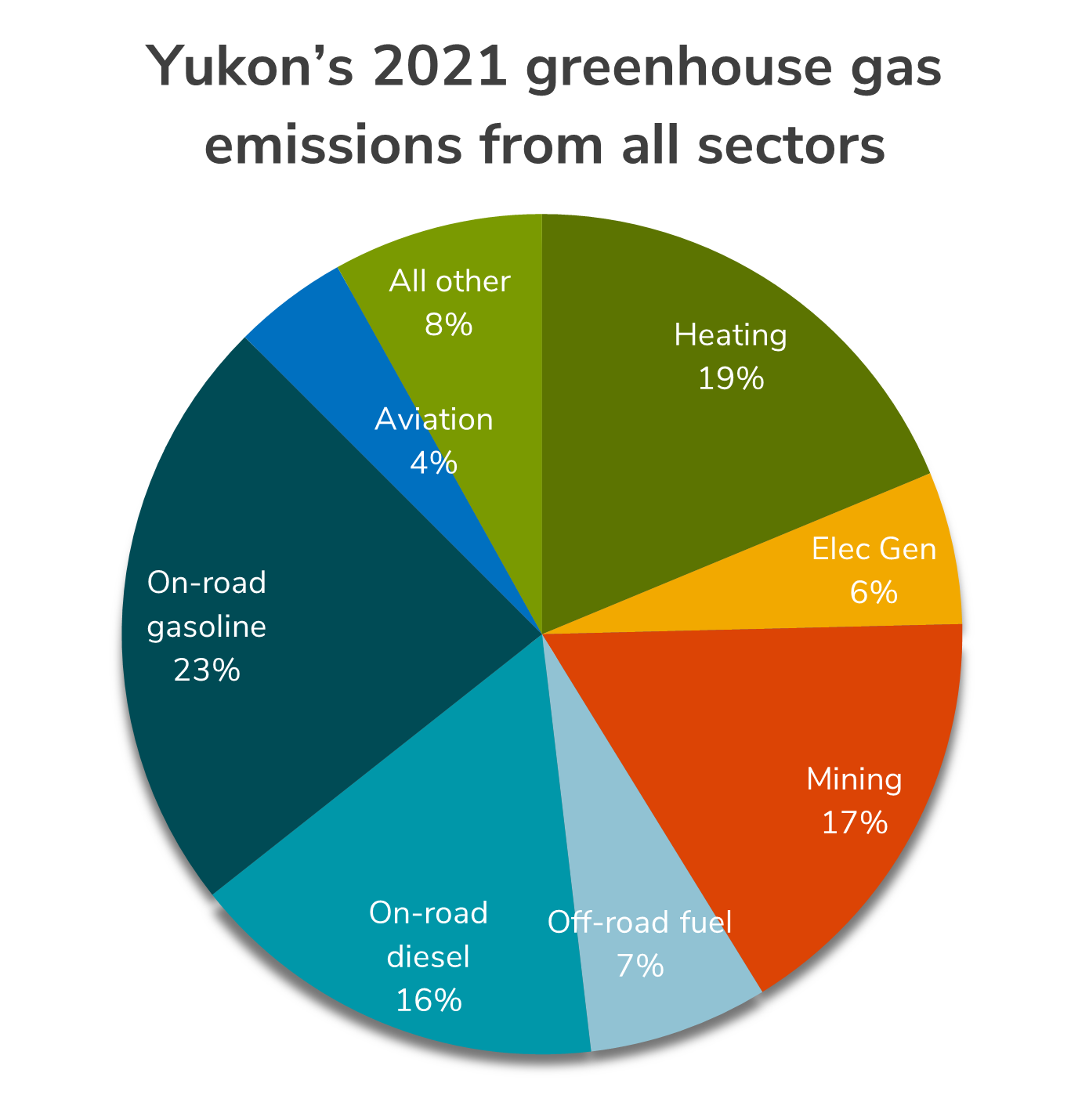
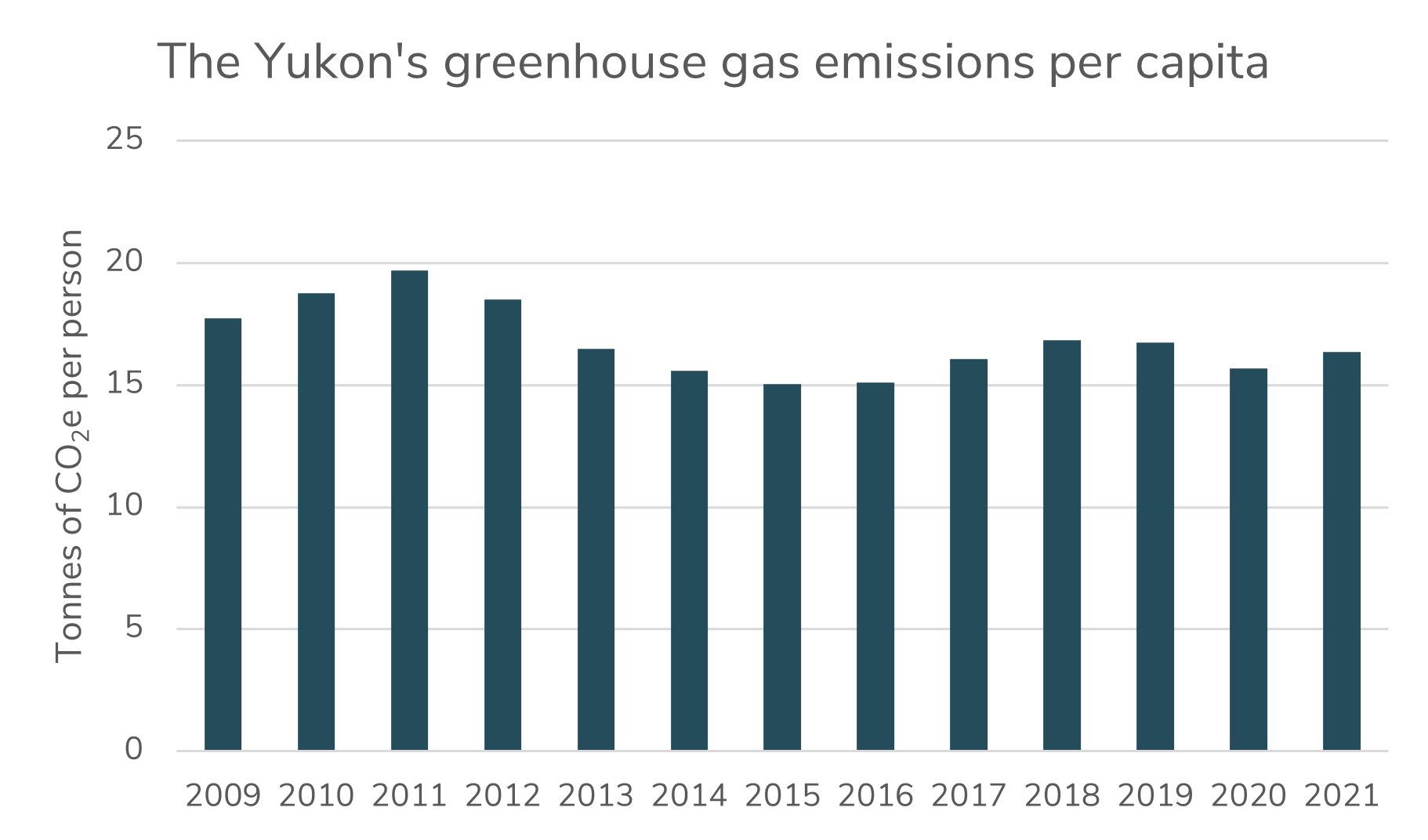
While the Yukon’s total greenhouse gas emissions are 0.1 per cent of Canada’s emissions because of our small population, our per person emissions of around 16.4 tonnes per person are the 5th highest in Canada and higher than many other countries.
What are our greenhouse gas reduction targets?
Our target is to reduce Yukon’s total greenhouse emissions by 45% below 2010 levels by 2030. This includes emissions from transportation, heating, electricity generation, other commercial and industrial activities, waste and other areas.
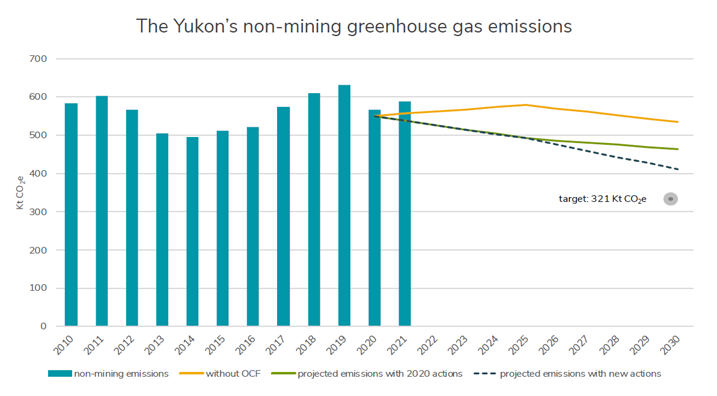
Based on modelling, we estimate that we need to reduce the Yukon’s 2030 greenhouse gas emissions by 321 kilotonnes. The actions in Our Clean Future are focused on reducing our emissions towards this goal.
Read about Our Clean Future to learn more about how we will close this gap.
We also have a plan to address greenhouse gas emissions from mining, which are not part of the 45% reduction target described above. Our Clean Future includes a commitment to work with industry to set a target for greenhouse gas emissions from placer and quartz mining that will see Yukon mines produce fewer emissions of greenhouse gases across their lifecycle for every kilogram or kilotonne of material produced.
This intensity-based target will encourage industry to look for innovative ways to reduce energy use and greenhouse gas emissions from mining, regardless of how many mines are operating.
From 2009 to 2021, emissions from placer and quartz mining have varied from year to year depending on the amount of mining activity in the Yukon. Overall, mining emissions ranged from 8 to 17% of the Yukon’s total emissions over this period.
How are the Yukon’s emissions calculated?
The Yukon’s greenhouse gas emissions are calculated using two main sources of information to provide the most accurate picture of the Yukon’s emissions:
- the Government of Canada’s National Inventory Report , which reports greenhouse gas emissions across the country; and
- information about fossil fuel sales in the Yukon collected by the Yukon Bureau of Statistics.
The Yukon’s greenhouse gas emissions only account for emissions that are produced within the Yukon’s borders. For example, a truck that drives from British Columbia to the Yukon to deliver food will produce greenhouse gas emissions in both British Columbia and the Yukon. By looking at truck logs that report how many kilometres were driven in the Yukon, we can figure out how much of the truck’s emissions count toward the Yukon’s total. Greenhouse gas emissions are tracked and reported on the basis of political borders to avoid double counting when reporting Canadian or global emissions.
Read the latest reports on Yukon's greenhouse gas emissions:
What are the Government of Yukon’s greenhouse gas emissions?
In 2019, Government of Yukon emission reporting was expanded to include both government departments and corporations. As government corporation data was collected for the first time, data for these organizations is not available prior to 2019.
In 2021, emissions from the Government of Yukon’s operations, including government corporations, but excluding electricity generation emissions, made up approximately 7% of the Yukon’s total greenhouse gas emissions at 49.9 kilotonnes of CO2 equivalent.
Government of Yukon department emissions mainly come from building heating, followed by transportation, electricity and other sources, such as refrigerants and waste.
Read the latest reports on the Government of Yukon's emissions:
-
Yukon Climate Leadership Council
The Government of Yukon established the Yukon Climate Leadership Council in November 2021. Eleven people with diverse backgrounds, knowledge and expertise were selected to serve a 1-year term.
Using the current Our Clean Future strategy as a framework, the council produced a report to support the government’s effort to reach the 45 per cent greenhouse gas emissions reduction target.
The work of the Yukon Climate Leadership Council directly resulted in new actions being added to the government’s Our Clean Future strategy. The new actions enhance the Yukon’s effort to reduce greenhouse gas emissions towards the 45 per cent reduction target.
Read the Our Clean Future 2022 annual report to learn about the new actions. They are highlighted in Appendix D.
Previous
For questions about climate change in the Yukon, email climatechange@yukon.ca or phone 867-334-6713.